Introduction
Most B2B SaaS companies fail not because they build bad products, but because they lack a clear go-to-market strategy. Research shows that 90% of startups fail, and poor market fit combined with weak GTM execution ranks among the top three reasons.
A go-to-market strategy is your plan for how you bring your product to customers and generate revenue. It includes who you sell to, how you reach them, what you charge, and how you close deals. Without this roadmap, you waste money on the wrong channels, target the wrong customers, and miss your revenue targets.
For B2B SaaS companies, GTM strategy differs from other business models in critical ways. Your customers make rational, research-heavy decisions. They involve multiple stakeholders. They expect free trials or demos. They need ongoing support and integration with existing tools. Your GTM approach must account for all of this.
The cost of getting it wrong is steep. Companies burn through funding on ineffective marketing campaigns. Sales teams chase leads that never convert. Product teams build features nobody asked for. Launches fall flat. Growth stalls.
This guide will walk you through building and executing a GTM strategy that fits your specific business. You will learn how to identify your ideal customers, choose the right sales model, allocate resources effectively, and measure what matters. We will cover both domestic and international expansion strategies, including faster, lower-risk approaches for entering new markets.
Whether you are launching your first product or expanding into new markets, you will find a practical framework you can apply to your business today.
Building Your B2B SaaS GTM Foundation
Understanding Your Ideal Customer Profile
Your ideal customer profile (ICP) defines the companies that get the most value from your product and generate the most value for your business. This differs from a buyer persona, which describes individual decision-makers.
Start with your current customer data. Look at your best customers based on retention, expansion revenue, and satisfaction scores. What do they have in common? Examine company size, industry, revenue range, technology stack, growth stage, and organizational structure.
Identify the pain points your product solves for these customers. A clear ICP includes firmographic data (size, industry, location), technographic data (existing tools, technical capabilities), and behavioral data (buying patterns, decision-making process).
Slack provides a good example. In their early growth stage, they focused on technology companies with 50-500 employees that already used modern collaboration tools. These companies understood the value of better communication and had budgets for software tools. They could implement new tools quickly without lengthy approval processes.
Common mistakes include defining your ICP too broadly to maximize market size, focusing on aspirational customers rather than realistic targets, and basing your ICP on assumptions rather than data. A narrow, well-defined ICP helps you focus resources and craft messaging that resonates.
Determining Your ACV Band and What It Means for Your Strategy
Annual Contract Value (ACV) represents the average yearly revenue per customer. This number fundamentally shapes your entire GTM strategy because it determines how much you can afford to spend acquiring each customer.
B2B SaaS companies typically fall into three ACV bands. Low ACV ranges from $0 to $15,000 annually. Mid ACV covers $15,000 to $100,000. High ACV includes anything above $100,000.
Your ACV band dictates your sales motion. Low ACV products require a self-service or inside sales model because field sales costs too much per deal. Mid ACV products work with inside sales teams that handle multiple deals simultaneously. High ACV products justify dedicated account executives and potentially field sales teams.
Consider a marketing automation tool with $5,000 ACV. You cannot afford to pay a sales rep $80,000 per year to close these deals through lengthy sales processes. You need a product-led approach with automated onboarding and minimal human touch until customers request it.
Compare this to an enterprise data platform with $250,000 ACV. You can invest in a dedicated sales team, custom demos, proof of concepts, and extended sales cycles because the deal size supports these costs.
Resource allocation scales with ACV. Low ACV requires investment in product experience, self-service tools, and digital marketing. High ACV demands investment in sales team development, custom implementation support, and relationship building.
Mapping Your Buyer Journey
The B2B SaaS buying journey includes distinct stages: awareness, consideration, evaluation, decision, and adoption. Each stage requires different content, touchpoints, and sales activities.
During awareness, potential customers identify a problem but may not know solutions exist. During consideration, they research potential solutions and shortlist vendors. During evaluation, they compare specific products through demos, trials, and reference calls. During decision, they negotiate terms and get internal approvals. During adoption, they implement and onboard users.
You must understand the difference between decision-makers, influencers, and end users. The VP of Sales may make the final purchase decision. The sales operations manager may research options and provide recommendations. Individual sales reps will actually use your product. Your strategy must address all three groups.
Sales cycle length varies by ACV band. Low ACV products average 1-3 months. Mid ACV products take 3-6 months. High ACV products often require 6-18 months. These timelines affect cash flow planning and growth projections.
Your product-led versus sales-led approach changes the journey significantly. Product-led companies let users try the product early in the process. Sales-led companies control access and guide buyers through structured evaluation processes. Product-led shortens cycles but may result in lower initial ACV. Sales-led extends cycles but typically closes larger deals.
Map specific content and touchpoints to each stage. Awareness stage needs educational content like blog posts and guides. Consideration stage requires comparison content and case studies. Evaluation stage demands product demos and free trials. Decision stage benefits from ROI calculators and reference customers. Adoption stage needs onboarding resources and success programs.
Choosing Your GTM Channels and Sales Model
Product-Led vs Sales-Led vs Hybrid Models
Your sales model determines how customers discover, evaluate, and purchase your product. The three primary models each fit different business situations.
Product-led growth lets customers try and adopt your product with minimal sales involvement. Users sign up, experience value quickly, and upgrade when they need more features or capacity. This model works best for products with low complexity, intuitive interfaces, and ACV below $15,000.
Sales-led growth involves sales teams guiding customers through the entire buying process. Prospects cannot access the product without talking to sales. This model suits complex products, long implementation cycles, and ACV above $100,000.
Hybrid models combine elements of both approaches. Customers might start with a self-service trial but engage with sales for enterprise features or larger deployments. This model works well for mid-market products with ACV between $15,000 and $100,000.
Dropbox exemplifies product-led growth. Users signed up for free accounts, stored files, and upgraded as they needed more storage. The product sold itself through a simple, valuable user experience.
Salesforce built their business on sales-led growth. Enterprise customers needed customization, integration, and change management support. Sales teams guided implementations and built long-term relationships.
Atlassian demonstrates the hybrid approach. Developers could start using Jira or Confluence with minimal friction. As usage expanded across teams or enterprises, Atlassian's sales team engaged to support larger deployments.
Resource requirements vary significantly. Product-led requires heavy investment in product experience, onboarding flows, and self-service support. Sales-led demands investment in sales team hiring, training, and enablement. Hybrid models need both but can phase investments as you learn what works.
Product-led offers faster time-to-revenue and lower customer acquisition costs but may limit initial deal sizes. Sales-led provides larger deals and better enterprise relationships but requires more upfront investment and longer payback periods. Hybrid models balance these trade-offs but add operational complexity.
Building Your Channel Mix
Your channel mix defines how you reach and acquire customers. Most B2B SaaS companies use multiple channels that work together to drive growth.
Direct sales teams remain the foundation for most B2B SaaS companies. Inside sales teams work remotely, handling multiple accounts through phone and video calls. Field sales teams meet customers in person for high-value deals. Inside sales works for ACV up to $50,000. Field sales makes sense for ACV above $100,000.
Structure your sales team based on specialization. Some companies separate prospecting and closing roles. Sales development reps (SDRs) qualify leads and book meetings. Account executives (AEs) run demos and close deals. This specialization improves efficiency but adds management complexity.
Channel partnerships extend your reach without expanding your team. Partners can include resellers who sell your product directly, referral partners who introduce qualified leads, technology partners who integrate with your product, and implementation partners who help customers deploy your solution. Our ultimate channel partner strategy guide provides detailed frameworks for building effective partner programs.
Digital marketing channels drive awareness and generate leads. Content marketing through blog posts, guides, and videos builds organic traffic. Paid search captures high-intent buyers actively searching for solutions. LinkedIn advertising targets specific job titles and companies. Email marketing nurtures leads over time. Each channel requires different investment levels and produces different return profiles.
Community-led growth leverages user communities to drive adoption and advocacy. Users help each other, share best practices, and become product champions. This approach works particularly well for developer tools and technical products where users value peer learning.
Prioritize channels based on where your ICP spends time and how they prefer to buy. Developer tools succeed with community and content marketing. Enterprise software requires field sales and industry events. SMB solutions benefit from inside sales and digital advertising.
Test new channels systematically. Start with a hypothesis about which channel might work. Set a specific budget and timeline. Define success metrics upfront. Run the test for at least 90 days to account for sales cycle length. Analyze results and decide whether to scale, optimize, or shut down the channel.
Pricing and Packaging Strategy
Your pricing model and packaging structure directly impact your GTM motion and customer acquisition efficiency. The wrong pricing approach creates friction and slows growth.
B2B SaaS companies use several pricing models. Per-user pricing charges based on the number of people using the product. Per-feature pricing creates tiers with different capabilities. Usage-based pricing charges based on consumption like API calls or storage. Flat-rate pricing offers unlimited usage for a fixed fee.
Per-user pricing works well for collaboration tools and products where value scales with team size. It creates predictable revenue but may limit adoption if customers restrict licenses to control costs. Per-feature pricing helps you serve different customer segments with different needs. It creates clear upgrade paths but requires careful feature allocation.
Usage-based pricing aligns costs with value received. Customers pay more as they get more value. This reduces barriers to starting but creates revenue volatility. Flat-rate pricing simplifies buying decisions and encourages broad adoption but may leave money on the table with power users.
Package your product to guide customers toward the right tier. Good packaging makes the middle tier most attractive for your target customer. Create clear differentiation between tiers based on features, usage limits, or support levels. Avoid creating too many tiers that overwhelm buyers.
Freemium models offer basic functionality forever at no cost. Users upgrade when they need more features or capacity. Free trials provide full access for a limited time. Users convert or lose access when the trial ends. Freemium works better for product-led models with viral potential. Free trials suit sales-led approaches where you want to prove value before asking for commitment.
Pricing page transparency affects your sales cycle. Public pricing reduces sales involvement but may scare away customers who need custom solutions. Hidden pricing requires sales conversations but creates friction for buyers who want to self-educate. The right choice depends on your sales model and deal complexity.
Zendesk demonstrates effective multi-tier pricing. They offer plans for teams of different sizes with clear feature differentiation. Small teams start with basic support tools. Large enterprises access advanced features like custom roles and multiple brands. Each tier targets specific customer segments with appropriate pricing and capabilities.
Common pricing mistakes include underpricing to win deals, creating too many tiers that confuse buyers, hiding pricing when transparency would help, failing to raise prices as you add value, and not testing different pricing approaches. Your initial pricing will not be perfect. Plan to iterate based on customer feedback and conversion data.
Executing Your GTM Strategy
Building Your GTM Team
Your team structure must match your GTM strategy and stage of growth. The wrong team composition wastes resources and slows execution.
Core GTM roles include sales, marketing, and customer success. Sales roles range from SDRs who prospect to AEs who close deals to account managers who expand existing customers. Marketing roles include demand generation to create leads, content marketing to build awareness, and product marketing to position your offering. Customer success ensures customers adopt your product and renew their contracts.
Alignment between these functions determines execution quality. Sales and marketing must agree on lead quality standards. Marketing needs to understand what sales hears from prospects. Customer success must feed product feedback to marketing and alert sales to expansion opportunities. Weekly cross-functional meetings help maintain alignment.
Your hiring sequence depends on stage and funding. Most companies hire in this order: first sales hire (founder initially), first marketing hire, first customer success hire, second sales hire or SDR, first dedicated content person. This sequence ensures you learn what works before scaling the team.
The in-house versus outsourced decision depends on your timeline, budget, and market knowledge. In-house teams provide better control and product knowledge but require time to hire and train. Outsourced teams offer faster deployment and specialized expertise but may lack deep product understanding. Many companies start with outsourced support for specific functions like content creation or lead generation, then bring capabilities in-house as they scale.
Team structure varies by ACV band. Low ACV products need minimal sales headcount with heavy investment in marketing and product. High ACV products require larger sales teams with supporting sales engineers and implementation specialists. Mid ACV products balance both approaches with inside sales supported by strong marketing.
Creating Your GTM Timeline and Milestones
A realistic GTM timeline typically spans 90 to 180 days from planning to initial results. Rushing this process leads to poor execution. Taking too long burns resources without learning.
The pre-launch phase takes 30 to 60 days. During this phase, you finalize your ICP and positioning, build your initial content and collateral, set up your tech stack and tracking, hire or train your team, and define your success metrics. This groundwork determines execution quality.
The launch phase takes 30 to 45 days. You activate your channels, begin outreach to prospects, start content publication, attend or host initial events, and generate your first leads. This phase tests your assumptions and reveals what needs adjustment.
The post-launch phase runs for 60 to 90 days. You analyze early results, optimize messaging and positioning, refine your ICP based on actual conversations, scale channels that work, and shut down channels that fail. This phase separates companies that adapt from those that stick with failed approaches.
Resource allocation shifts across phases. Pre-launch requires heavy planning and setup effort. Launch demands execution focus across all channels. Post-launch needs analytical capacity to identify patterns and optimization opportunities.
Signs you are off track include no qualified leads after 60 days, conversion rates below 1% from lead to opportunity, sales cycles 50% longer than expected, high customer churn in first 90 days, or your team cannot articulate your value proposition clearly. Address these issues immediately rather than hoping they resolve themselves.
Measuring GTM Success
You cannot improve what you do not measure. The right metrics reveal whether your GTM strategy works and where to focus optimization efforts.
Essential GTM metrics start with customer acquisition cost (CAC). Calculate total sales and marketing spend divided by number of new customers. This tells you how much you invest to acquire each customer. Track this monthly to spot trends.
Lifetime value (LTV) represents total revenue you expect from a customer over their entire relationship with your company. Calculate average annual revenue per customer multiplied by average customer lifetime in years. Your LTV should be at least three times your CAC for a healthy business model.
CAC payback period measures how long it takes to recover customer acquisition costs. Calculate CAC divided by monthly revenue per customer. Payback periods under 12 months indicate strong unit economics. Payback periods over 24 months create cash flow challenges.
Win rate shows the percentage of qualified opportunities that close. Calculate closed-won deals divided by total qualified opportunities. Win rates below 20% suggest poor qualification or weak positioning. Win rates above 40% indicate strong product-market fit.
Sales cycle length measures days from first contact to closed deal. Track this by deal size and source. Longer cycles tie up resources and slow growth. Identify patterns in faster-closing deals and replicate them.
Leading indicators predict future performance. These include marketing qualified leads (MQLs), sales qualified leads (SQLs), pipeline coverage ratio, demo request rate, and trial-to-paid conversion rate. Leading indicators let you make changes before they impact revenue.
Lagging indicators report past performance. These include closed revenue, customer count, churn rate, and net revenue retention. Lagging indicators confirm whether your changes worked but do not give early warning signs.
Set realistic targets based on your stage and ACV band. Early-stage companies with low ACV might target 50-100 new customers per month with $10,000 CAC. Mid-stage companies with mid ACV might target 20-30 customers per month with $30,000 CAC. Later-stage companies with high ACV might target 5-10 customers per month with $100,000 CAC.
Build a simple dashboard that tracks these metrics weekly. Share it across your GTM team. Review it in weekly meetings. When metrics decline, investigate root causes immediately. When metrics improve, document what drove the change so you can repeat it.
Knowing when to pivot versus persist challenges every company. Pivot when your core assumptions prove wrong, such as targeting the wrong ICP or choosing the wrong sales model. Persist when your assumptions prove correct but execution needs refinement, such as improving messaging or optimizing channels. Give strategies at least 90 days before making major changes to account for sales cycle length.
International GTM Strategy for B2B SaaS
When to Consider International Expansion
International expansion offers significant growth opportunities but introduces new complexity and risk. Timing matters. Expand too early and you spread resources too thin. Wait too long and competitors establish strong positions in attractive markets.
Signs you are ready for international markets include strong product-market fit in your home market with consistent revenue growth and positive unit economics. You should have repeatable sales processes and proven channel strategies. Your product should handle multiple languages and currencies. You need surplus capital or cash flow to fund expansion.
Common mistakes include expanding internationally before establishing strong domestic traction, entering too many markets simultaneously, underestimating cultural and regulatory differences, and failing to commit adequate resources. Companies often assume international markets work exactly like their home market. This assumption leads to failed launches and wasted investment.
Prioritize target markets based on multiple factors. Market size and growth rate indicate opportunity scale. Cultural and language proximity affect go-to-market difficulty. Existing customer concentration may signal organic demand. Competitive landscape determines how hard you must fight for market share. Regulatory environment impacts speed to market and operational complexity.
Conduct focused market research before committing resources. Interview potential customers in target markets. Analyze local competitors and their positioning. Understand buying behaviors and decision-making processes. Identify regulatory requirements for data privacy, security, and industry-specific compliance. Review payment method preferences and contract norms.
Regulatory and compliance considerations vary significantly by market. European markets require GDPR compliance for data handling. Some industries need local data storage. Certain countries require local business entities for B2B contracts. Tax implications affect pricing strategy. Employment laws impact team building. Address these requirements early in your planning process.
International GTM Approaches
You have several options for entering international markets. Each approach offers different trade-offs between control, speed, risk, and investment level.
Building local teams provides maximum control and long-term market presence. You hire local sales, marketing, and support staff. This approach works well for strategic markets where you plan significant investment. However, it requires substantial upfront capital, takes 6-12 months to establish, and carries high fixed costs before generating revenue. You need deep local knowledge to hire effectively and navigate employment laws.
Remote coverage from your home market minimizes investment but limits effectiveness. Your existing team covers new markets remotely. This works for initial market testing or markets with strong English adoption and digital-first buying behaviors. However, time zone differences complicate customer interaction. You lack local market presence and cultural understanding. Sales cycles often extend due to limited face-to-face engagement.
Partnership models leverage existing local organizations to enter markets faster. These include reseller partners who sell your product as part of their portfolio, referral partners who introduce qualified leads for fees, and system integrators who implement your solution as part of larger projects. Partnership models reduce upfront investment and provide local market knowledge. However, you sacrifice some control and margin. Partner quality varies significantly. Building effective partner programs requires dedicated resources.
Using local outsourced sales companies offers a compelling middle ground for many B2B SaaS companies. These specialized firms provide full-service market entry from lead generation through closing deals. This approach delivers several key benefits.
Reduced risk stands out as a primary advantage. You pay for performance rather than carrying fixed team costs. If a market underperforms, you can adjust investment quickly. You avoid long-term employment commitments while testing market potential.
Faster time-to-market accelerates revenue generation. Outsourced sales companies already have trained teams, established processes, and active pipelines. You can start generating pipeline within weeks rather than months. This speed matters when entering competitive markets or responding to inbound demand.
Local expertise improves execution quality. These companies understand local business culture, buying behaviors, and competitive dynamics. They have existing relationships and market credibility. They navigate regulatory requirements and contract norms effectively. This knowledge reduces costly mistakes and improves win rates.
Lower upfront investment preserves capital. You avoid costs for hiring, training, office space, and benefits. You pay for results rather than activity. This model works particularly well for mid-stage companies that need to scale internationally without raising additional funding.
The full-service approach covers the entire sales process. The outsourced team generates leads through outbound prospecting and digital campaigns. They qualify opportunities and understand customer needs. They run product demonstrations and handle objections. They negotiate contracts and close deals. They can even support initial customer onboarding. This comprehensive coverage lets you focus internal resources on product development and strategic accounts.
When evaluating outsourced sales partners, assess several factors. Review their track record with similar B2B SaaS companies. Understand their team structure and how they would staff your account. Examine their sales methodology and tools. Clarify pricing models and performance expectations. Check references from current and past clients. Ensure they understand your product category and can represent your value proposition effectively.
One European marketing automation company used this approach to enter the North American market. Rather than hiring a US-based sales team, they partnered with a specialized outsourced sales company. Within 90 days, the partner generated qualified pipeline and closed initial deals. The company learned about US market dynamics, refined their positioning, and validated demand before making larger commitments. After 12 months of strong performance, they hired their own US team, using insights gained through the partnership.
Our ultimate GTM strategy guide provides additional frameworks for evaluating market entry approaches and building comprehensive international expansion plans.
Adapting Your Strategy for Local Markets
Successful international expansion requires adapting your GTM strategy for local market conditions. What works in your home market will not automatically work elsewhere.
Product localization goes beyond simple translation. You need to translate the interface, documentation, and support content into local languages. Consider feature adjustments for local requirements like different reporting standards, local payment methods, or regional integrations. Ensure your product complies with local data privacy and security regulations. Test your product with local users to identify usability issues.
Pricing adjustments reflect local market conditions. Economic conditions vary significantly between markets. A price point that works in the US may price you out of emerging markets or leave money on the table in premium markets. Currency fluctuations affect actual revenue. Local competition may force different positioning. Many companies adjust pricing by market while maintaining consistent packaging tiers.
Marketing message adaptation accounts for cultural differences in how buyers evaluate solutions. Some markets respond to ROI-focused messaging. Others prioritize relationship building and trust. Risk tolerance varies significantly. Innovation adoption rates differ. Your messaging should reflect local business culture while maintaining consistent brand positioning.
Sales cycle differences by region require process adjustments. European buyers often take longer to make decisions with more consensus required. Asian markets may emphasize relationship building before discussing product details. North American buyers typically move faster but demand more proof points. Adjust your sales process, content requirements, and resource allocation accordingly.
Payment method requirements vary significantly. Credit card payments dominate in North America. Bank transfers remain common in Europe. Some markets require specific local payment processors. Invoice payment terms differ by region. Support for purchase orders matters more in some markets. Offer payment options that match local preferences to reduce friction.
Cultural considerations in sales approach affect win rates. Meeting expectations for in-person versus remote engagement differs by market. Decision-making processes involve different organizational levels. Negotiation styles vary from direct to indirect. Gift-giving customs and business entertainment norms require awareness. Personal relationship importance versus transactional interactions shifts by culture. Train your teams or partners on these differences to improve effectiveness.
Timeline expectations for international GTM must account for learning curves. Plan for 6-12 months to establish market presence and generate consistent pipeline. Initial deals often take longer than your home market average as you refine positioning and build credibility. Budget for iterative testing of messaging, channels, and sales approaches. Most companies underestimate the time and resources required for successful international expansion.
Common GTM Mistakes and How to Avoid Them
Strategic Mistakes
Strategic mistakes in GTM planning undermine execution before you start. These errors waste resources and delay finding product-market fit.
Targeting too broad of a market dilutes your message and spreads resources too thin. Companies fear missing opportunities by focusing narrowly. In reality, trying to serve everyone means you serve no one particularly well. Your messaging becomes generic. Your product development lacks focus. Your sales team struggles to identify qualified prospects. Instead, define a narrow ICP you can dominate. Expand once you own that segment.
Misalignment between product readiness and GTM timing creates poor first impressions. Launching before your product reliably delivers value generates negative word-of-mouth. Customer churn undermines growth. Sales teams lose confidence. Wait until your product consistently solves the core problem for your ICP. Polish can come later, but core functionality must work.
Choosing your sales model based on competitors rather than customer needs leads to inefficient resource allocation. Just because competitors use field sales does not mean you should. Your ACV, product complexity, and target customer may support a different approach. Analyze what makes sense for your specific business model. Test your assumptions rather than copying others.
Underestimating sales cycle length causes cash flow problems and missed targets. Founders often assume sales cycles will match their best early deals from warm relationships. Reality brings longer cycles as you sell to cold prospects. Build financial models around realistic cycle lengths for your ACV band. Plan for cycles to extend as you move upmarket or enter new segments.
Ignoring customer feedback during GTM execution prevents learning and adaptation. You invested time developing your strategy. Natural human bias wants to prove it works. However, early customer conversations reveal problems with positioning, pricing, or product fit. Listen carefully to why prospects do not buy. Track common objections. Adjust your approach based on patterns you observe.
Execution Mistakes
Execution mistakes turn sound strategies into failed launches. These errors reflect inadequate planning or poor cross-functional coordination.
Insufficient sales enablement and training leaves your team unprepared to sell effectively. Sales people need deep product knowledge, competitive positioning, objection handling techniques, demo scripts, and qualification frameworks. They need access to case studies, ROI calculators, and proposal templates. Invest in comprehensive onboarding and ongoing training. Update materials as you learn what works.
Poor handoff between marketing and sales creates friction and wasted leads. Marketing generates leads that sales considers unqualified. Sales complains about lead quality while failing to follow up promptly. Define clear lead qualification criteria together. Implement service level agreements for response times. Create feedback loops so marketing understands what sales hears from prospects. Weekly meetings between teams improve coordination.
Inconsistent messaging across channels confuses prospects and weakens your brand. Your website says one thing. Sales decks say another. SDRs use different positioning than AEs. Customer success describes value differently than marketing. Document your core positioning and value propositions. Train every customer-facing person on consistent messaging. Review all content to ensure alignment.
Not tracking the right metrics prevents learning and optimization. Companies track vanity metrics like website traffic or social media followers that do not correlate with revenue. Focus on metrics that directly impact growth like qualified pipeline, win rate, and customer acquisition cost. Build dashboards that surface problems early. Review metrics weekly with your team.
Scaling too quickly before proving your model burns through resources without sustainable growth. You hire rapidly, expand to new channels, and enter new markets based on early success. However, early wins may not be repeatable. Wait until you demonstrate consistent performance over multiple quarters. Prove your unit economics work. Then scale with confidence.
One enterprise software company launched an expensive field sales motion based on their vision of serving large enterprises. After 18 months and millions spent, they had closed only a handful of deals. Sales cycles exceeded 18 months. Win rates stayed below 10%. They pivoted to a product-led approach with inside sales support. This model matched their actual product complexity and customer buying preferences. Within a year, they exceeded the previous model's total revenue with a team one-third the size.
Conclusion and Next Steps
Summary of Key Takeaways
Building an effective GTM strategy for B2B SaaS requires matching your approach to your specific business model. Your ICP and ACV band determine your sales motion, channel mix, and team structure. No universal template works for every company.
Start with a clear understanding of who buys your product and why. Define your ICP based on data from your best customers. Calculate your ACV and understand what sales approach it supports. Map your buyer journey including all stakeholders and typical timeline.
Choose a sales model that fits your product and market. Product-led works for simple products with low ACV. Sales-led suits complex products with high ACV. Hybrid approaches balance both but add complexity. Build a channel mix that reaches your ICP where they already spend time.
Execute systematically with clear timelines and milestones. Build the right team for your stage and model. Track metrics that matter and review them weekly. Adjust based on what you learn but give strategies adequate time to prove themselves.
International expansion offers growth opportunities but requires careful planning. Use approaches that match your resources and risk tolerance. Consider outsourced sales partners for faster, lower-risk market entry. Adapt your strategy for local market conditions.
Avoid common mistakes by focusing narrowly, aligning product readiness with launch timing, and choosing strategies based on your business rather than competitors. Invest in enablement, track the right metrics, and prove your model before scaling.
Most importantly, remember that your initial GTM strategy will not be perfect. Plan to iterate based on market feedback. The companies that succeed adjust their approach based on what they learn while maintaining focus on their core ICP.
Action Steps
Take these specific steps to build and implement your GTM strategy.
Step one involves defining your ICP and ACV band. Analyze your current customer data to identify patterns among your best customers. Calculate your average ACV and understand which band you fall into. Document your ICP including firmographic, technographic, and behavioral characteristics. Share this with your entire team so everyone targets the same customers.
Step two requires choosing your sales model and channel mix. Based on your ACV and product complexity, decide whether product-led, sales-led, or hybrid makes sense. Identify which channels will reach your ICP most effectively. Prioritize two to three channels to start rather than trying everything at once. Allocate budget and resources to those priorities.
Step three focuses on building your team and timeline. Hire the roles most critical for your chosen model. Create a 90 to 180 day timeline with specific milestones. Allocate resources across pre-launch, launch, and post-launch phases. Build in time for learning and adjustment.
Step four establishes your measurement framework. Define the key metrics you will track weekly. Set realistic targets based on your stage and ACV band. Build a simple dashboard that surfaces these metrics. Schedule weekly review meetings with your GTM team. Document what you learn and what changes you will test.
Step five centers on execution, measurement, and iteration. Launch your strategy according to your timeline. Track results against your metrics. Identify what works and what does not. Make adjustments based on data rather than opinions. Give changes adequate time to prove themselves. Scale channels and approaches that consistently perform.
For companies considering international expansion, add a sixth step. Evaluate target markets based on opportunity size and strategic fit. Choose an expansion approach that matches your resources and risk tolerance. Consider outsourced sales partners for faster, lower-risk market entry. Adapt your strategy for local market conditions.
Additional Resources
Continue building your GTM expertise with these resources.
Our ultimate GTM strategy guide provides comprehensive frameworks for every aspect of go-to-market planning and execution. This guide covers market research, competitive analysis, positioning, and launch planning in depth.
Our channel partner strategy guide helps you build effective partner programs that extend your market reach. Learn how to identify, recruit, enable, and manage channel partners for sustainable growth.
Need help developing your specific GTM strategy? We offer GTM strategy consultations and assessments for B2B SaaS companies at all stages. Our team helps you define your ICP, choose the right sales model, build your channel mix, and execute your international expansion plans. Contact us to discuss your specific situation and explore how we can accelerate your growth.
If you're wondering if your company is even ready to expand internationally...
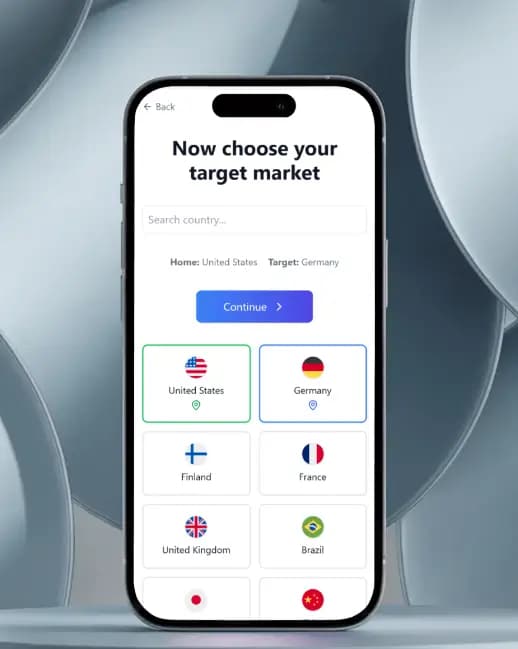
We created a quiz game for companies to find out if they're ready. You only need to pick your home market, target market, answer a generic questions about your company (don't worry, all anonymous), and questions about market entry and it'll give you an answer about your company's readiness to expand. It takes only 5 minutes to complete but could save you years and a lot of money. Give it a try here!